# Article 6 of the Paris Agreement: The Global Carbon Markets Explained
> What Article 6 of the Paris Agreement is, how Article 6.2 and 6.4 work, what COP29 agreed, and how corresponding adjustments prevent double-counting of international credits.
**Source:** https://www.esgweise.com/insights/article-6-paris-agreement-carbon-markets/
**Author:** Sumit Agarwal
**Published:** 2026-06-02
**Frameworks:** Article 6, Paris Agreement
**Countries:** UAE, KSA, Qatar, Global
---
## Key points
- Article 6 of the Paris Agreement governs international cooperation on carbon markets.
- Article 6.2 covers bilateral cooperation, trading ITMOs between countries.
- Article 6.4 is a centralised UN mechanism (PACM) issuing credits under a Supervisory Body.
- COP29 (Baku, 2024) operationalised both; corresponding adjustments prevent double-counting.
---
## Introduction
Carbon markets are increasingly global, and the rules that let one country's reductions count toward another's target sit in **Article 6 of the Paris Agreement**. After nearly a decade of negotiation, COP29 finally made it work. For any company or country engaging in international carbon markets — including across the GCC — Article 6 is now the governing framework. This guide explains it. It connects to [ITMOs](/insights/itmos-explained-article-6-2/) and [carbon credits in the GCC](/insights/carbon-credits-in-the-gcc/).
## What Article 6 does
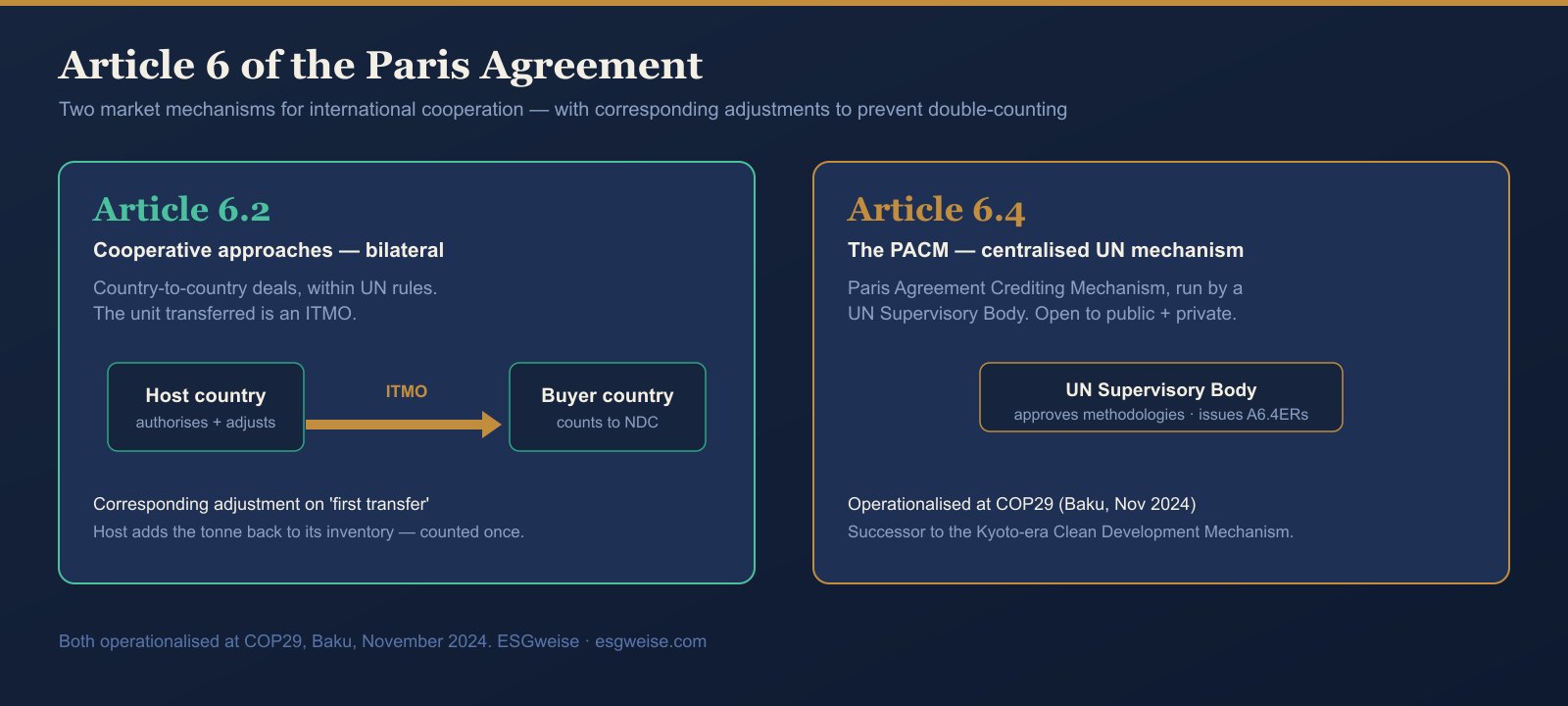
Article 6 lets countries **cooperate to meet their climate targets (NDCs)**, including through carbon markets, to raise ambition and lower the cost of climate action. It contains two market mechanisms:
| | **Article 6.2** | **Article 6.4** |
|---|---|---|
| **Structure** | Decentralised, bilateral | Centralised UN mechanism (PACM) |
| **Unit** | ITMO | A6.4ER (mechanism credit) |
| **Governance** | Country-to-country, within UN rules | UN Supervisory Body |
| **Participants** | Governments | Public and private |
## Article 6.2 — cooperative approaches
Under **Article 6.2**, two or more countries agree **bilaterally** to transfer mitigation outcomes — **[ITMOs](/insights/itmos-explained-article-6-2/)** — setting their own arrangements within UN transparency rules. By late 2024, dozens of bilateral agreements had been signed, though completed transfers remain few.
## Article 6.4 — the Paris Agreement Crediting Mechanism
**Article 6.4** is a **centralised UN crediting mechanism** — the **Paris Agreement Crediting Mechanism (PACM)** — governed by a **Supervisory Body** that approves methodologies and issues credits, open to public and private participants. It is, in effect, the successor to the Kyoto-era Clean Development Mechanism.
COP29 (Baku, November 2024) was the breakthrough. Parties finalised Article 6.2 rules — including authorisation, the definition of the 'first transfer' that triggers accounting, and transparency requirements — and, on the first day, adopted the standards for Article 6.4 methodologies and carbon-removal activities. This operationalised both mechanisms nearly a decade after Paris, clearing the way for the first Article 6.4 credits and for ITMO transfers to scale.
Article 6.2 is country-to-country deals; Article 6.4 is a global crediting system. COP29 was the moment both stopped being theory and started issuing real units.
## Corresponding adjustments — the anti-double-counting rule
The linchpin of Article 6 integrity is the **corresponding adjustment**. When a host country transfers a mitigation outcome, it must **add that tonne back to its own inventory**, so only the buyer counts it. Without it, both host and buyer claim the same tonne — collapsing the system's credibility. The **'first transfer'** is the point at which this accounting is triggered.
## Why it matters for the GCC
GCC states are active participants — as buyers, hosts and market-builders. The [UAE's National Carbon Register](/insights/carbon-credits-in-the-gcc/) explicitly aligns credits with Article 6, and the region is pursuing [bilateral 6.2 agreements](/insights/itmos-explained-article-6-2/). For GCC companies, Article 6 increasingly shapes which international credits are usable and how.
## How ESGweise helps
ESGweise helps GCC organisations navigate Article 6 — understanding ITMO and 6.4 eligibility, corresponding-adjustment requirements, and how international credits fit their strategy. See our [carbon](/services/carbon/) and [strategy](/services/strategy/) practices.
## References & sources
- [UNFCCC — Article 6 cooperative implementation](https://unfccc.int/process-and-meetings/the-paris-agreement/cooperative-implementation)
- [UNFCCC — Article 6.4 mechanism (PACM)](https://unfccc.int/process-and-meetings/the-paris-agreement/cooperative-implementation/article-64-mechanism)
- [UNFCCC — COP29 outcomes](https://unfccc.int/cop29)
## Conclusion
Article 6 of the Paris Agreement is the rulebook for international carbon cooperation: Article 6.2 for bilateral ITMO trades, Article 6.4 for a centralised UN crediting mechanism, and corresponding adjustments to stop the same tonne being counted twice. COP29 in Baku operationalised it all after nearly a decade. For the GCC — active as buyer, host and market-builder — Article 6 is now the framework that governs credible participation in the global carbon market.
## Related reading
Related guides cover [the GCC energy realism argument after COP30](/insights/cop30-vindicated-the-gcc-s-energy-realism-strategy-o-g-perspective/), [what a US withdrawal from climate commitments would mean](/insights/the-usa-s-threat-to-withdraw-from-climate-commitments-what-it-means-for-global-sustainability/).
---
## Frequently asked questions
### What is Article 6 of the Paris Agreement?
Article 6 is the part of the Paris Agreement that enables countries to cooperate internationally to meet their climate targets (NDCs), including through carbon markets. It has two market mechanisms: Article 6.2, which allows countries to trade emission reductions bilaterally as Internationally Transferred Mitigation Outcomes (ITMOs); and Article 6.4, a centralised UN-supervised crediting mechanism. Article 6 aims to raise ambition and lower the cost of climate action through cooperation.
### What is the difference between Article 6.2 and Article 6.4?
Article 6.2 is decentralised: two or more countries agree bilaterally to transfer mitigation outcomes (ITMOs), setting their own arrangements within UN rules. Article 6.4 is centralised: it is a single UN mechanism — the Paris Agreement Crediting Mechanism (PACM) — governed by a Supervisory Body that approves methodologies and issues credits, open to both public and private participants. Think of 6.2 as country-to-country deals and 6.4 as a global crediting system.
### What did COP29 agree on Article 6?
COP29 in Baku (November 2024) operationalised Article 6 after nearly a decade of negotiation. It finalised key rules for Article 6.2 — including authorisation, the definition of 'first transfer', and transparency requirements — and adopted the standards needed to make Article 6.4 (the PACM) operational, including standards for methodologies and carbon-removal activities. This cleared the way for the first Article 6.4 credits to be issued and for ITMO transfers to scale.
### What is a corresponding adjustment?
A corresponding adjustment is the accounting step that prevents double-counting when a mitigation outcome is transferred internationally. When a host country sells an ITMO, it must add that tonne back to its own emissions inventory (a corresponding adjustment), so only the buying country or entity counts the reduction toward its target. Without a corresponding adjustment, both the host and the buyer would claim the same tonne — which would undermine the integrity of the whole system.
---
Published by ESGweise Global LLC, Dubai. https://www.esgweise.com