
A step-by-step guide to registering a carbon-credit project, from methodology and PDD to validation, registration, verification and issuance, and how long each stage takes.
Introduction
Turning a real-world climate activity — a solar farm, a mangrove restoration, a methane-capture system — into tradable carbon credits is a structured, audited journey. Skip a step and the credits never issue; rush the additionality case and validation fails. This guide walks through the full carbon-project lifecycle. It complements our guide to the registries and additionality.
The carbon project lifecycle
Every credited project moves through the same six stages, regardless of standard:
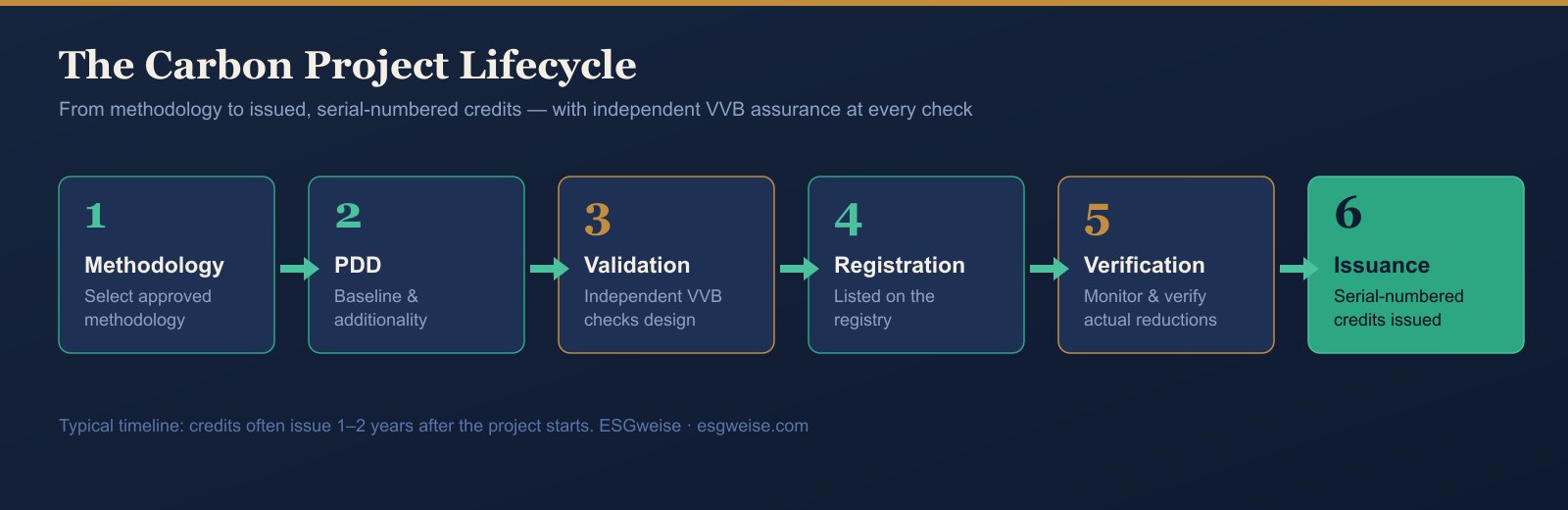
| Stage | What happens | Who |
|---|---|---|
| 1 · Methodology | Select an approved methodology for the project type | Developer |
| 2 · PDD | Write the Project Design Document: activity, baseline, additionality, monitoring | Developer |
| 3 · Validation | Independent check that the design meets the rules | VVB |
| 4 · Registration | Project listed on the registry | Standard |
| 5 · Monitoring & verification | Measure actual reductions; independent verification | Developer + VVB |
| 6 · Issuance | Serial-numbered credits issued | Registry |
The PDD is everything
The Project Design Document (PDD) is the heart of the process. It must set out the baseline (what would have happened anyway), demonstrate additionality (that the reductions would not have happened without carbon finance), and define exactly how reductions will be quantified and monitored. A weak PDD is the single most common reason projects fail validation.
Validation and verification
Two independent checks by an accredited Validation and Verification Body (VVB) give credits their credibility:
- Validation (once, up front): does the design meet the standard’s rules?
- Verification (periodic): did the claimed reductions actually happen, per the monitoring data?
Only after successful verification does the registry issue credits — each uniquely serial-numbered to prevent double-counting.
A carbon project lives or dies on its PDD. Everything downstream — validation, registration, issuance — is really just the market checking whether the baseline and additionality case hold up.
Plan for time and cost
Credits do not issue overnight. Expect several months for the PDD, several more for validation, then a monitoring period before the first verification — so credits often appear one to two years after the project starts. Validation, monitoring and verification all cost money. Building that timeline and budget in from the outset separates viable projects from stranded ones.
How ESGweise helps
ESGweise supports carbon-project developers in the GCC and beyond — selecting the right methodology, writing validation-ready PDDs, building the monitoring plan, and managing the VVB relationship through to issuance. See our carbon practice and our guides to additionality and choosing a registry.
References & sources
- Verra — Verified Carbon Standard programme
- Gold Standard — for the Global Goals
- UNFCCC — Article 6.4 mechanism (Supervisory Body standards)
- ISO 14064-2 — project-level GHG quantification
Conclusion
Registering a carbon project is a six-stage lifecycle — methodology, PDD, validation, registration, verification, issuance — anchored by a rigorous PDD and independent VVB assurance. Credits issue only after real, monitored reductions are verified, often one to two years in. Understand the lifecycle, invest in the PDD, and plan for the timeline, and a project can generate credible credits. Underestimate any of them, and it stalls.
Frequently asked questions
How do you register a carbon credit project?
You select an approved methodology for your project type, write a Project Design Document (PDD) setting out the activity, baseline and additionality case, and submit it to a standard such as Verra or Gold Standard. An independent Validation and Verification Body (VVB) validates the design; once validated, the project is registered on the standard's public registry. The project then operates, monitors its reductions, and undergoes periodic verification before credits are issued.
What is a Project Design Document (PDD)?
The PDD is the foundational document of a carbon project. It describes what the project does, the methodology applied, the baseline scenario (what would have happened without the project), how emission reductions are quantified and monitored, and the additionality case. The PDD is what the VVB validates and what the registry publishes, so it must be rigorous, transparent and evidence-based.
What is a VVB (Validation and Verification Body)?
A VVB is an accredited, independent third-party auditor that assesses carbon projects. At validation, the VVB confirms the project design meets the standard's rules, including additionality and methodology applicability. At each subsequent verification, the VVB checks that the claimed reductions actually occurred, based on monitoring data. This independent assurance is what gives issued credits their credibility.
How long does it take to register a carbon project and issue credits?
It varies by project type and standard, but a realistic path is several months to develop the PDD, several more months for validation, and then a monitoring period before the first verification and issuance — so credits often appear one to two years after the project starts. Larger or nature-based projects can take longer. Building time and cost for validation, monitoring and verification into the project plan from the outset is essential.