
Hydrogen additionality, temporal and geographical correlation explained under EU Regulation 2023/1184, including monthly matching now and hourly matching from 2030.
Introduction
Whether your hydrogen counts as green comes down to one question: is the electricity that made it genuinely renewable? EU Regulation 2023/1184 answers that question with a set of rules known as additionality and correlation. Get this right and your electricity is scored at zero carbon, which is usually what allows a project to pass. Get it wrong and the whole project fails, regardless of how much solar or wind it uses. This article explains the three rules and the two routes through them.
Why this is the decisive question
Under the RFNBO greenhouse gas method, fully renewable electricity is counted as zero emissions. Because electricity is the dominant input to electrolysis, that zero is what pulls a project’s carbon number below the 28.2 gCO2e/MJ threshold. So the electricity qualification is not a side issue. It is the single most important decision in the whole certification, which is why Regulation 2023/1184 is so detailed.
The two routes
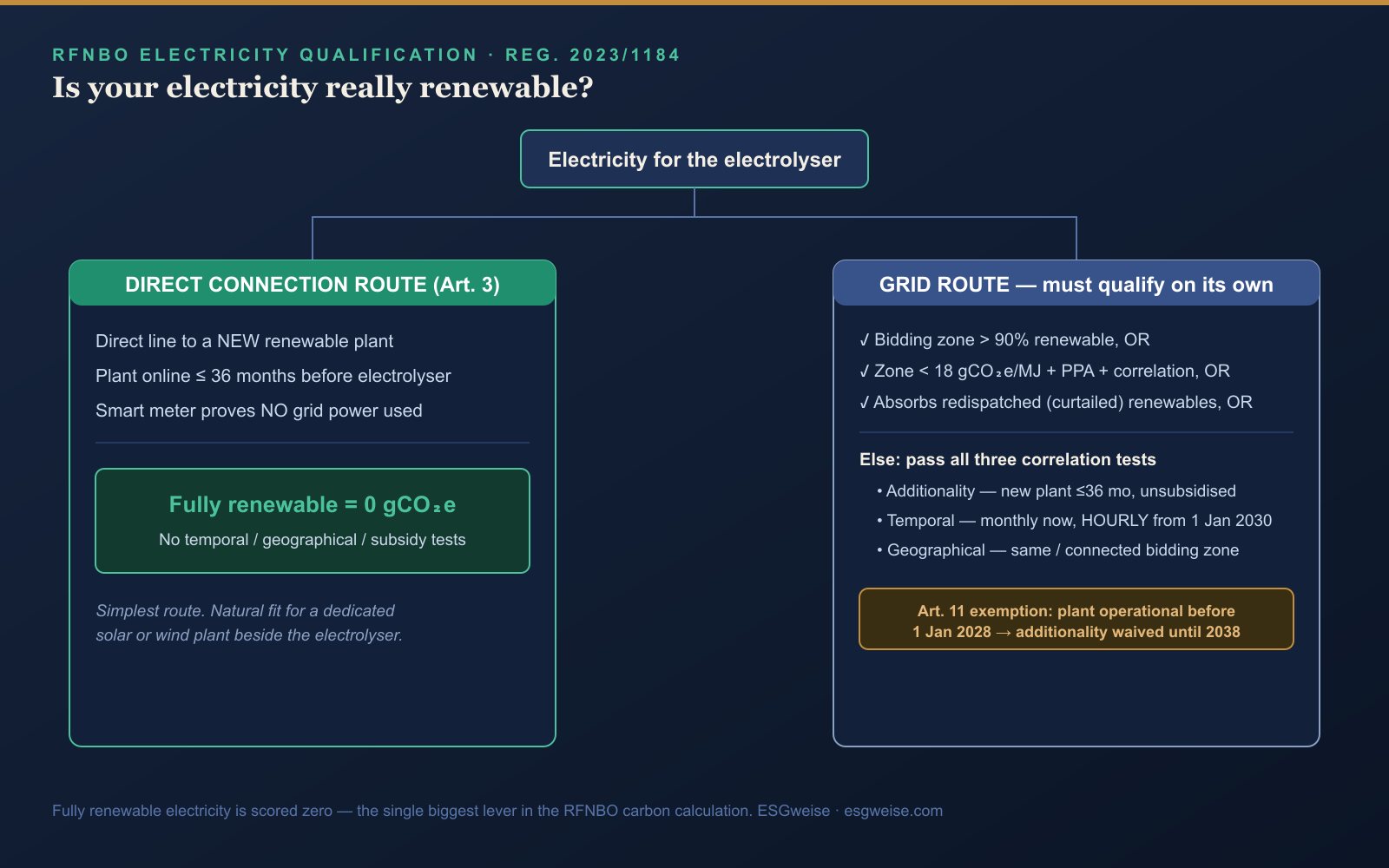
There are two ways to qualify the electricity. The diagram below shows how they branch.
The direct connection route
The direct connection route, under Article 3, is the simpler path. It applies when the electrolyser is joined to a new renewable plant by a direct line, or is part of the same installation, and a smart meter proves that no grid power is used for production. If the renewable plant came into operation no more than 36 months before the electrolyser, the electricity counts as fully renewable and is scored at zero.
The advantage is significant. This route carries no temporal, geographical or subsidy correlation tests. For a producer building a dedicated solar or wind plant next to the electrolyser, this is usually the cleanest way to qualify, and it is a natural fit for many projects in the Gulf.
The grid route
If the electrolyser draws power from the grid, that power has to qualify on its own. There are several ways it can:
| Grid qualification path | Condition |
|---|---|
| High-renewable zone | The bidding zone is more than 90% renewable |
| Low-carbon zone with a PPA | The zone is below 18 gCO2e/MJ, plus a power purchase agreement and correlation |
| Absorbing curtailment | The electrolyser absorbs renewable power that would otherwise be curtailed |
| Full correlation | Additionality, temporal correlation and geographical correlation all pass |
The three correlation rules
When a project falls to the full correlation path, three rules apply.
Additionality means the renewable plant is new, built no more than 36 months before the electrolyser, and unsubsidised. The intent is that green hydrogen should create new renewable capacity, not consume existing supply.
Temporal correlation means matching production to renewable generation in time. The matching window is monthly today, and becomes hourly from 1 January 2030. Hourly matching is much stricter, because a project can no longer average across a month to cover hours when the sun is not shining or the wind is not blowing.
Geographical correlation means the renewable generation and the electrolyser are in the same or a connected bidding zone, so the electricity could physically have flowed between them.
Additionality asks a simple question with expensive consequences: did your hydrogen build new renewable power, or just borrow someone else’s?
What this means for producers
For most new projects, the design goal is to qualify through the direct connection route, because it avoids the correlation tests entirely. Where that is not possible and grid power is used, the project has to be engineered and documented to pass additionality, temporal and geographical correlation, with an eye on the 2030 shift to hourly matching. For a non-EU site, concepts such as the bidding zone need an equivalent justification, which is part of the readiness work for a GCC export project.
How ESGweise helps
ESGweise helps producers determine which route their project should take, evidence the direct connection or grid qualification correctly, and plan for hourly matching from 2030. We build the analysis before the audit, so the electricity qualification is defensible. See our carbon accounting and assurance readiness services, and the full picture in the CertifHy pillar guide.
Conclusion
Additionality and correlation decide whether your electricity, and therefore your hydrogen, counts as green. The direct connection route is the simplest path to a zero-carbon electricity score and avoids the correlation tests. The grid route is workable but demanding, and it gets harder in 2030 when matching goes hourly. Because this one question determines whether a project passes, it deserves the most careful attention, and the earliest.
Related guides
Frequently asked questions
What is additionality for green hydrogen?
Additionality means the renewable electricity used to make hydrogen comes from a new renewable plant, built specifically for the purpose rather than diverted from existing supply. Under EU Regulation 2023/1184, the renewable plant must be new, generally built no more than 36 months before the electrolyser, and unsubsidised. The principle is that green hydrogen should drive new renewable capacity, not consume renewable power that would have served other users.
What is temporal correlation and what changes in 2030?
Temporal correlation means the hydrogen production has to be matched in time to the renewable generation that powers it. Today the matching is monthly, meaning production and renewable generation are balanced over a calendar month. From 1 January 2030, matching becomes hourly, meaning production in a given hour must be backed by renewable generation in the same hour. Hourly matching is significantly stricter and shapes how projects are designed and operated.
What is the direct connection route?
The direct connection route, under Article 3 of Regulation 2023/1184, applies when the electrolyser is connected to a new renewable plant by a direct line, or is part of the same installation, and a smart meter proves no grid power is used for production. If the renewable plant came into operation no more than 36 months before the electrolyser, the electricity counts as fully renewable and zero carbon. This route carries no temporal, geographical or subsidy correlation tests, so it is much simpler to evidence.
Is there an exemption from the additionality rule?
Yes. Under Article 11, electrolysers that come into operation before 1 January 2028 have the additionality requirement waived until 2038. This transitional provision was designed to support early projects. Which transitional provisions apply to a given project depends on its commissioning date, so it should be confirmed carefully during project design.