
A complete guide to CertifHy and EU RFNBO certification for green hydrogen and ammonia: the rules, the 70% threshold, additionality, and the route to the EU market.
Introduction
CertifHy is the certification scheme most producers will use to prove that their green hydrogen and ammonia meet the European Union’s RFNBO rules. If you are building an electrolyser or a green ammonia plant and you intend to sell into Europe, RFNBO certification is what turns “we make green hydrogen” into a recognised qualification that EU buyers, regulators and the European Hydrogen Bank will accept. This guide explains the whole scheme end to end: what CertifHy is, the rules behind it, the numbers you have to hit, and the path from a project on paper to a certificate in hand.
What CertifHy is and why it exists
CertifHy is a voluntary certification scheme, recognised by the European Commission, for hydrogen and its derivatives. It is operated by the CertifHy Scheme Operator and its current rulebook is built around the EU RFNBO framework. RFNBO stands for Renewable Fuel of Non-Biological Origin. In plain terms, it is hydrogen (or a hydrogen derivative such as ammonia or methanol) made from renewable electricity rather than from biomass or fossil sources.
The scheme exists because a green claim on its own is not enough for the EU market. A buyer, a regulator or a funding body needs independent proof that the hydrogen was made with genuinely additional renewable power and that its lifecycle carbon footprint is low enough. CertifHy provides that proof in a form the EU recognises.
The two layers: EU law and the CertifHy scheme
Certification stacks two layers, and it helps to keep them separate in your mind.
The first layer is EU law, which sets the non-negotiable rules. The parent directives are the Renewable Energy Directive, RED II (Directive (EU) 2018/2001) and its amendment RED III (Directive (EU) 2023/2413). Two delegated regulations supply the detail:
| Regulation | What it decides |
|---|---|
| EU 2023/1184 | Additionality, and temporal and geographical correlation. Is your electricity really renewable? |
| EU 2023/1185 | The greenhouse gas savings method and the threshold. What is your carbon number? |
The second layer is the CertifHy scheme documents, which are the operating manual. They set out how you prove compliance, who is allowed to audit you, how the chain of custody works, and how the certificate is issued and maintained.
Master three questions and you hold most of the scheme: is the electricity renewable, what is the carbon number, and how do you keep the green attribute attached to the right molecules. The sections below take each in turn.
Is your electricity really renewable?
This is the decisive question, governed by Regulation 2023/1184. It decides whether the power feeding your electrolyser can be counted as fully renewable, and therefore as zero carbon. There are two routes.
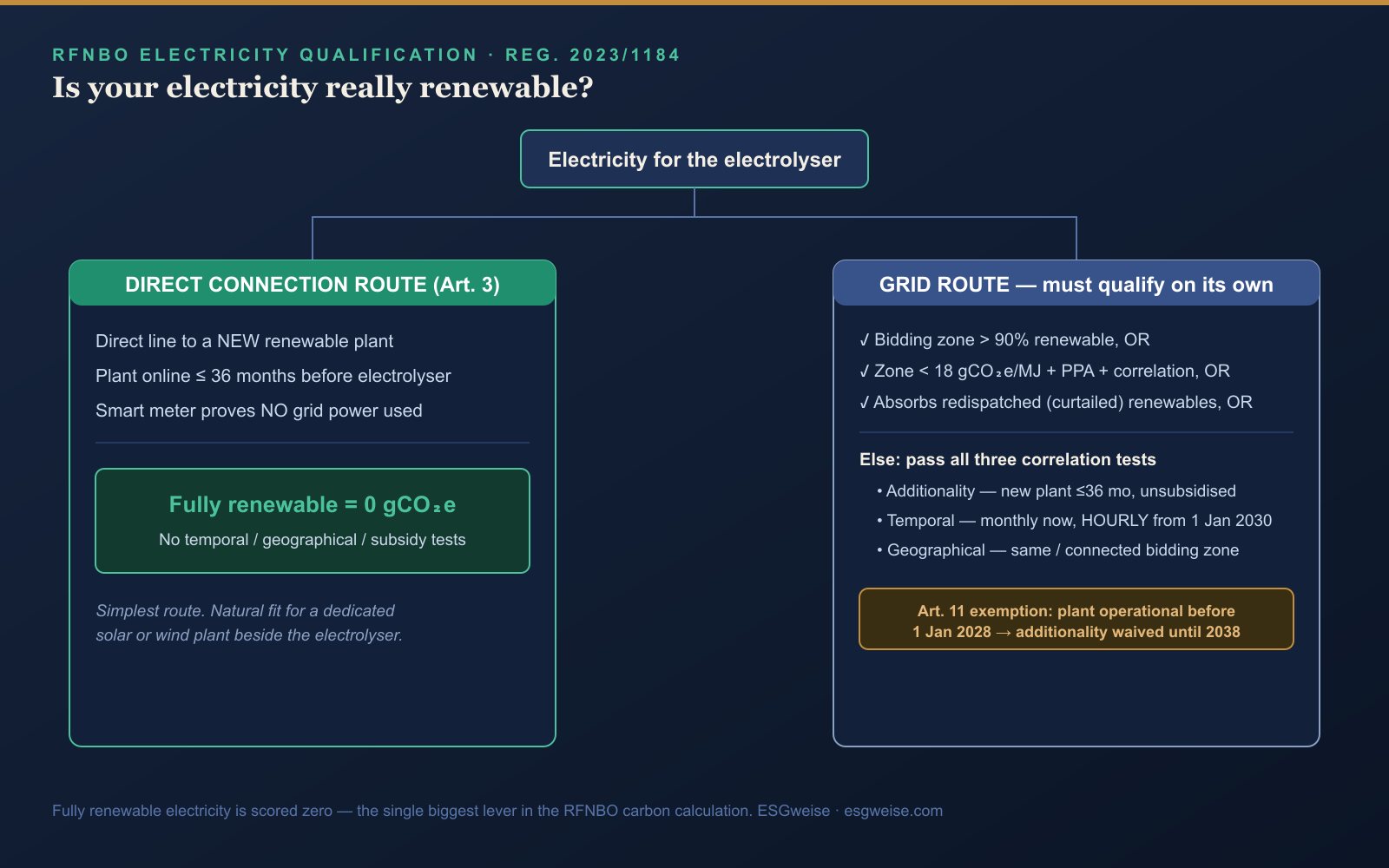
The direct connection route (Article 3 of Regulation 2023/1184) is the simpler one. If the electrolyser is joined to a new renewable plant by a direct line, or is part of the same installation, and that plant came into operation no more than 36 months before the electrolyser, and a smart meter proves that no grid power is used for production, then the electricity counts as fully renewable and is scored at zero grams of CO2e. This route carries no temporal, geographical or subsidy correlation tests, which makes it far simpler to evidence.
The grid route applies when the electrolyser draws power from the grid. Grid power must then qualify on its own. It can qualify if the bidding zone is more than 90% renewable, or if the zone is below 18 gCO2e/MJ and the producer holds a power purchase agreement with correlation, or if it absorbs renewable power that would otherwise be curtailed. Failing those, the power must pass the three correlation tests: additionality (the renewable plant is new, built no more than 36 months before the electrolyser, and unsubsidised), temporal correlation, and geographical correlation.
Temporal correlation is tightening. Production must be matched to renewable generation monthly today, and hourly from 1 January 2030. There is one important transitional exemption: plants that come into operation before 1 January 2028 have the additionality requirement waived until 2038, under Article 11.
What is your carbon number?
Once the electricity question is settled, Regulation 2023/1185 sets the carbon calculation and the pass mark. The lifecycle emissions are calculated with a single formula:
E = e_i + e_p + e_td + e_u − e_ccs
The terms are inputs, processing, transport and distribution, use, and captured carbon that is subtracted. The saving is then measured against a fossil comparator of 94 gCO2e/MJ:
saving = (94 − E) / 94
The fuel passes if the saving is at least 70%, which means the carbon intensity E must be below 28.2 gCO2e/MJ. This is the number every RFNBO project is built around.
Proving it: chain of custody for ammonia
Hydrogen is often converted to ammonia for shipping, because ammonia is easier to transport. Ammonia has no separate standard. It is certified through three things: a certified renewable hydrogen input, a lifecycle footprint that meets the threshold, and a chain of custody that keeps the green attribute attached to the right volumes as the ammonia moves and mixes.
The chain-of-custody method is mass balance. Book and claim is not allowed. Green and non-green ammonia may be mixed in one storage tank as long as the green volume drawn out never exceeds the green volume put in over each balancing period, the period is no longer than three months and closes with no deficit, and the attribute set is transferred whole rather than split. In practice the green attribute lives in the ledger, not in any particular molecule. Co-mingled port storage is where most of the certification risk sits, especially when the tank is operated by a third party, which requires a written contract to forward the CertifHy claim.
Pre-certification versus full certification
A full certificate requires an operating plant producing real consignments. That is a problem for a project that is still being designed and financed. Pre-certification solves it. It is a design-stage dry run that tests the project’s design against the rules before construction, so the eventual operational audit passes cleanly. The first CertifHy EU green ammonia pre-certification, for a project in India, was completed in June 2024, which established the model for the sector.
The full certification process runs from registration, through a self-assessed risk review, to an on-site audit by a recognised Certification Body that must begin within six months of registration. A certificate is valid for one year and is maintained through surveillance audits and re-certification.
RED III, the Hydrogen Bank and market access
Certification is not a compliance chore, it is a commercial key. RED III and the European Hydrogen Bank are the reason. RED III raised EU ambition and set binding sub-targets: hydrogen used in industry must be at least 42% RFNBO by 2030 and at least 60% by 2035. The European Hydrogen Bank channels support to certified renewable hydrogen. Without recognised RFNBO certification, a producer cannot count toward these targets or access this support, which is why certification is the ticket to the European market.
What this means for GCC exporters
For producers in the UAE, Saudi Arabia and Oman building at scale for export, the route from the Gulf to Europe runs through RFNBO certification. GCC projects often have a natural advantage on the electricity question, because a new solar plant on a direct line to the electrolyser can use the simpler direct connection route. The work is then to evidence it correctly, build the lifecycle calculation to include shipping to the EU port, and design the chain of custody through co-mingled storage. This is where early, structured readiness work pays for itself.
Certification does not make hydrogen green. It proves it. For a producer selling into Europe, that proof is the product.
How ESGweise helps
ESGweise is a greenhouse gas accounting, lifecycle assessment and climate advisory firm. We work as a readiness and calculation partner for RFNBO and CertifHy, not as a Certification Body. We help producers interpret the rules, build the greenhouse gas and lifecycle model to the 2023/1185 method, analyse the electricity qualification and additionality position, design the mass-balance chain of custody, and assemble the evidence so the certification audit runs cleanly. See our carbon accounting, assurance readiness and reporting services, and our note on how ISO 14064 GHG quantification and lifecycle assessment underpin this work.
Conclusion
CertifHy is the practical route to proving green hydrogen and ammonia meet the EU RFNBO rules. The scheme rests on two questions of EU law, whether the electricity is genuinely renewable and what the lifecycle carbon number is, and on a chain of custody that keeps the green attribute attached to the right volumes. The target is clear: a carbon intensity below 28.2 gCO2e/MJ, achieved above all by qualifying the electricity as fully renewable. For producers aiming at the European market, and for GCC exporters in particular, getting this right early is what turns a green project into a certified, sellable one.
Related guides
Frequently asked questions
What is CertifHy?
CertifHy is a voluntary certification scheme, recognised by the European Commission, that proves hydrogen and its derivatives such as ammonia meet the European Union's rules for Renewable Fuels of Non-Biological Origin (RFNBO). It combines the requirements of EU law with an operating manual for how producers prove compliance, who audits them, and how the paperwork flows. For producers who want to sell green hydrogen or ammonia into the EU, a recognised scheme like CertifHy is the practical way to demonstrate the product qualifies.
What is the difference between CertifHy and the RFNBO rules?
The RFNBO rules are set by EU law: the Renewable Energy Directive (RED II and RED III) and two delegated regulations, 2023/1184 and 2023/1185. These define what counts as truly renewable hydrogen and how to calculate its carbon footprint. CertifHy is a scheme that implements those rules in practice, providing the audit procedure, chain-of-custody method and certificate that give a producer's claim legal value for EU market access.
Does hydrogen or ammonia need to be certified to sell in Europe?
To count toward EU renewable targets, to access support such as the European Hydrogen Bank, and to satisfy RED III industry and transport sub-targets, hydrogen and ammonia generally need to be certified as RFNBO through a recognised voluntary scheme. Certification is what turns a green production claim into a recognised, tradable qualification in the EU market.
Can ESGweise certify my hydrogen or ammonia project?
No. Certification and verification can only be carried out by an accredited Certification Body, such as TUV SUD, TUV Rheinland, DEKRA, Bureau Veritas or SGS. ESGweise is an advisory and readiness partner. We help producers understand the rules, build the greenhouse gas and lifecycle calculations, design the chain of custody, and prepare so that the eventual audit passes cleanly. The scheme rules keep the advisor and the auditor separate, which is why readiness support and certification are two distinct roles.